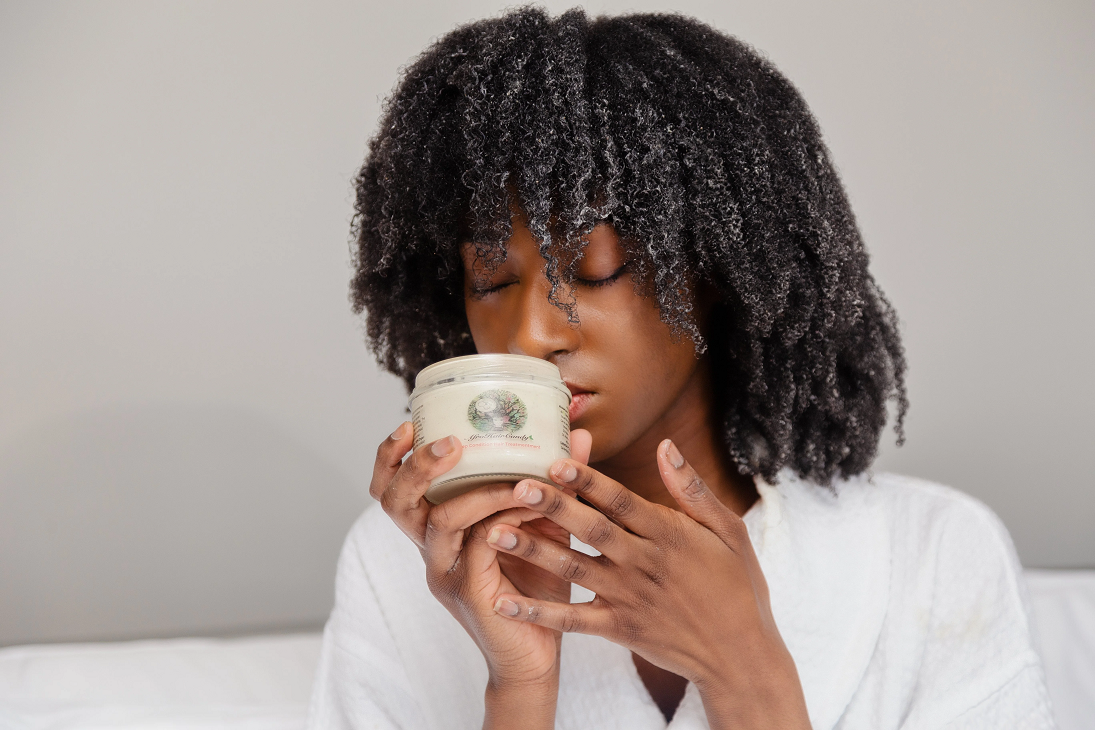
Gently cleanses the scalp and hair without stripping moisture.
Deep conditioning
Softens the hair, improves manageability, and restores hydration.
Moisturiser / Leave-In Conditioner
Provides daily moisture and keeps hair supple.
Refreshes hair between wash days and prevents dryness.
Sealing and protection
Seals in moisture and protects the ends.
The AfrohairCandy Standard
"If you cannot eat it — it does not belong on your hair."
This is not a marketing slogan. It is the standard that every ingredient, every supplier and every farm we work with must meet before anything enters a single AfrohairCandy formula. In six years of production — it has never been compromised. Not once.
"I grew up in a village in the Democratic Republic of Congo where we used plants, seeds and oils for everything. No chemicals. No synthetics. We ate from the same land we used to care for our hair and skin. The idea that you would put something on your body that you could not also put in it — that concept simply did not exist where I grew up. It still does not exist in our products."
Carine Mbembi Whyte · Founder, AfrohairCandy
WHAT IT MEANS
The principle in plain language
Every ingredient in every AfrohairCandy product must be something that exists in nature in a form that could be consumed as food or medicine without causing harm. Not processed into a laboratory compound. Not synthesised from petrochemicals. Not derived from a natural source through a process that strips away or transforms its original molecular structure beyond recognition. If it is a plant — the plant itself, or its cold-pressed oil, or its water extract, must be something a human could reasonably eat or use medicinally. Aloe Vera — you can eat it. Kola Nut — eaten across Central and West Africa for centuries. Hibiscus — drunk as a tea worldwide. Shea Butter — used as a cooking fat in West Africa for generations. Wild Congo Honey — a food. Okra — a food. Watermelon — a food. Lychee — a food. Avocado — a food. If you cannot say the same about an ingredient — if it exists only as a synthetic compound in a laboratory, if it requires industrial chemical processing to create, if it would cause harm if consumed — it does not belong on your hair or your skin. This is the standard. Applied to every ingredient. Without exception.
WHY IT MATTERS
Your skin is not a barrier. It is a door.
Most people treat their skin as a protective barrier that keeps things out. Modern cosmetic science understands something more complex — your skin is also a highly permeable organ that absorbs what you put on it directly into your bloodstream. Studies have shown that up to 60% of what you apply topically can be absorbed systemically. Lipid-soluble compounds — the kind found in oils, butters and many synthetic preservatives and fragrances — cross the skin barrier particularly effectively because they are chemically similar to the skin's own lipid structure. This means the ingredients in your hair products and skincare are not staying on the surface. They are entering your body. For most mainstream hair and beauty products — products containing parabens, synthetic preservatives, mineral oil, synthetic fragrances, sulphates and alcohol-processed essential oils — this absorption means regular low-level exposure to compounds that your body did not evolve to process. Parabens — used as preservatives in the majority of cosmetic products — have been detected in human breast tissue. Phthalates — found in synthetic fragrances — are endocrine disruptors that interfere with hormone function. Mineral oil — a petroleum byproduct used as a moisturiser in many hair products — forms an occlusive film that traps everything underneath it including bacteria and inflammatory compounds. These are not theoretical risks. They are documented biological realities. The #IfYouCantEatIt standard exists because if an ingredient is safe enough to eat — if your body has evolved alongside it over thousands of years of use as food or medicine — then your skin absorbing it is not a risk. It is simply nutrition delivered through a different route.
THE INGREDIENTS THAT PASS
You can eat every one of these
🌿
Aloe Vera
DRC Congo
Eaten as a supplement. Drunk as a juice. Used in food across Africa and Asia for centuries.
🌰
Kola Nut
DRC Congo — our farm
Eaten at ceremonies across Central and West Africa for centuries. The original cola flavouring.
🌺
Hibiscus
Senegal · Mali · Congo
Drunk as a tea worldwide. Used in West African cooking. A food plant used for generations.
🧈
Shea Butter
Our Ghana farm
Used as a cooking fat in West Africa for centuries. Also used medicinally and nutritionally.
🍯
Wild Congo Honey
DRC Congo — our farm
A food. Wild honey harvested from unfarmed bees in the Congo rainforest. Eaten as it is.
🫙
Okra
DRC Congo
A staple vegetable across Africa, the Caribbean and the American South. Eaten daily.
🍉
Watermelon
DRC Congo
A fruit. Grown on our Congo farm. Eaten fresh. Nothing more natural exists.
🥑
Avocado
DRC Congo
A food. Rich in healthy fats that nourish hair and skin from the outside exactly as they nourish the body from the inside.
🥥
Coconut Oil
Ghana · Nigeria
A cooking oil used across West Africa, South Asia and the Caribbean for centuries. Eaten and applied topically in equal measure.
🌱
Flaxseeds
South Africa · Ethiopia
A health food. Rich in Omega-3. Eaten as a supplement worldwide. The basis of our Hair Gel's hold.
🌿
Castor Oil
Senegal
Taken medicinally for centuries. Cold-pressed from the Castor plant native to Senegal.
🧄
Garlic
Various
A food. Used in cooking worldwide for thousands of years. Also one of nature's most potent antimicrobials.
🫚
Chebe Powder
Chad
Made from wild-harvested botanicals from the Lake Chad basin. Used both topically and in traditional medicine.
🍵
Neem
Burkina Faso · Mali
Neem leaves are eaten and used medicinally across Africa and Asia. Every part of the Neem tree has a culinary or medicinal use.
🌿
Baobab
Senegal
The Baobab fruit is eaten across Africa. The powder is sold in health food shops worldwide. A nutritional superfood.
🍫
Cocoa Butter
Ghana — our farm
The fat from the cacao bean — the same bean that makes chocolate. Absolutely edible. Used in confectionery worldwide.
WHY NO ESSENTIAL OILS
The question we are asked most often — answered honestly
Most natural and organic hair and skincare brands use essential oils extensively — and market them as the proof of their natural credentials. We do not use essential oils. This is one of the most deliberate and most misunderstood decisions in our formulation philosophy. Essential oils are produced through distillation or solvent extraction processes that use alcohol or other chemical solvents to extract and concentrate the aromatic compounds from plants. The alcohol that produces essential oils is the same alcohol we refuse to put anywhere near your scalp. This creates a problem that most brands do not acknowledge. You cannot claim to be free from alcohol and simultaneously use alcohol-processed essential oils in your formulas. The alcohol is present in the extraction process. Traces remain in the finished oil. And even where those traces are minimal — the principle is compromised. At AfrohairCandy the #IfYouCantEatIt standard applies to the process as much as to the ingredient itself. A plant that could be eaten becomes an essential oil through an alcohol extraction process. The essential oil is not the same thing as the plant. We use the plant — or its cold-pressed oil — not the alcohol extract. Instead of Lavender Essential Oil we use whole Lavender flower extracts and cold-pressed Lavender oil from Morocco and Tunisia. Instead of Peppermint Essential Oil we use fresh Peppermint and Peppermint leaves. Instead of Rosemary Essential Oil we use fresh Rosemary and cold-pressed Rosemary oil sourced from Morocco and Tunisia. The result is a formula built from whole plant materials — with their complete biological profiles intact — rather than concentrated alcohol extracts of their aromatic compounds. This is a more complex and more expensive formulation approach. It is also more honest. And it is what the #IfYouCantEatIt standard demands.
THE THINGS THAT FAIL THE TEST
What you will never find in an AfrohairCandy product — and why
Parabens
Synthetic preservatives derived from petrochemicals. Detected in human breast tissue in studies. Endocrine-disrupting properties documented. Not edible. Not natural.
Found in: The majority of mainstream shampoos, conditioners and styling products.
Mineral Oil
A petroleum byproduct. Forms an occlusive film on hair and skin that traps moisture — and bacteria, inflammatory compounds and product residue — underneath it. Not edible. Not plant-based.
Found in: Many mainstream moisturisers, hair oils and baby products marketed as gentle.
Sulphates — SLS/SLES
Synthetic detergent surfactants derived from petroleum or palm kernel oil through chemical processing. Strip the scalp's natural sebum layer entirely. Damage the scalp microbiome. Not edible.
Found in: Most conventional shampoos including many marketed as natural.
Silicones
Synthetic polymer compounds derived from silicon dioxide through industrial chemical processing. Create the illusion of smooth, shiny hair by coating the hair shaft — while building up over time and blocking follicles. Not edible. Not plant-based.
Found in: Most heat protectors, shine serums, conditioners and styling products.
Synthetic Preservatives
Compounds like methylisothiazolinone, formaldehyde-releasing agents and phenoxyethanol. Used to extend shelf life. Many have documented skin sensitisation, hormone disruption and carcinogenic risk at sufficient exposure levels.
Found in: The majority of products not labelled as preservative-free.
Alcohol — Denat / SD / Isopropyl
Microscopically desiccating. Causes moisture loss at the cellular level. Can cause microscopic damage to inflamed follicular tissue. The body responds with scar tissue that reduces blood flow to the follicle.
Found in: Many edge controls, hair gels, styling sprays and — through extraction processes — essential oils.
Synthetic Fragrance
A single "fragrance" listing can contain dozens of undisclosed synthetic compounds including phthalates — documented endocrine disruptors that interfere with hormone function. Not edible. Not plant-based.
Found in: The majority of hair care and skincare products including many marketed as natural.
Essential Oils
Produced through alcohol distillation or solvent extraction. You cannot claim to be alcohol-free and use alcohol-processed essential oil extracts. We use whole plant materials and cold-pressed oils instead — the complete botanical profile rather than the alcohol extract.
Found in: Most brands that market themselves as natural or botanical including many premium ranges.
THE HERITAGE BEHIND THE STANDARD
This principle is not new. It is ancient.
The #IfYouCantEatIt standard is not a principle Carine invented. It is the principle that governed beauty and body care in the village in Bandundu, Congo where she grew up — and in African communities across the continent — for centuries before synthetic cosmetics existed. In the Bandundu village the line between food and medicine and beauty care did not exist. The Aloe Vera plant provided food, medicine and hair treatment simultaneously. The Shea Nut was pressed for cooking oil and skin moisturiser from the same harvest. Wild honey was eaten at meals and applied to skin and hair. The same palm oil used in cooking went on the skin. Castor seeds native to Senegal were pressed for oil used both medicinally and in beauty care. The knowledge that what grows from the earth is safe for the body — inside and out — was not a philosophy. It was simply reality. The communities that held this knowledge did not need a slogan to describe it because the distinction between food-safe and body-safe did not exist for them. Everything they used for their bodies came from the same plants they used for their lives. What the synthetic cosmetics industry did — in the 20th century — was introduce a separation that had never existed before. Products for the body began to contain compounds that existed nowhere in nature and had no history of human use. Those compounds were effective at certain cosmetic tasks — they extended shelf life, created shine, held style, produced lather. But they came with biological costs that communities who had never used them had never needed to consider. The #IfYouCantEatIt standard is not a modern innovation. It is a return to the principle that governed body care for the entirety of human history before the synthetic era. Carine did not invent it in a boardroom. She carried it from a village in the Congo to a laboratory at Oxford to a studio in London. And she has never compromised it once.
THE SCIENCE BEHIND THE STANDARD
Why Oxford cellular biology agrees with the village
When Carine studied Biomedical Sciences and Cellular and Molecular Biology at the University of Oxford she did not discover that the principle she had grown up with was wrong. She discovered the mechanisms that explained why it was right. The skin's transdermal absorption pathway — the route by which compounds on the skin surface enter the bloodstream — is most permeable to lipid-soluble compounds with a molecular weight below approximately 500 Daltons. Most plant oils, botanical extracts and food-grade compounds fall within this range. So do most synthetic preservatives, phthalates and fragrance compounds. This means that both the food-safe ingredients in AfrohairCandy products and the synthetic compounds in most mainstream beauty products are absorbed transdermally. The difference is what each one does once it reaches the bloodstream. Food-safe compounds — compounds your body has co-evolved with over thousands of years of use as food and medicine — are recognised, metabolised and either used or safely excreted by your biological systems. Your liver, your kidneys, your immune system know what to do with Aloe Vera and honey and plant oils because human bodies have been processing them for millennia. Synthetic compounds that have existed in beauty products for only 50 to 100 years are a different question entirely. Your body has no evolved response to parabens because parabens did not exist in any form your ancestors encountered. Your body has no evolved mechanism for processing industrial petroleum byproducts because your ancestors did not encounter mineral oil. The accumulation of synthetic compounds in human tissue — including the detection of parabens in breast tissue and phthalates in blood and urine samples from populations using mainstream cosmetics — is the biological evidence that the village principle was right all along. #IfYouCantEatIt is not sentiment. It is cellular biology.
"But aren't all products required to be safe? Don't regulators test these things?"
Cosmetic safety regulation in most markets — including the UK and EU — is based on the principle that individual ingredients at specific concentrations are safe for short-term topical use. It does not test for the cumulative long-term effect of daily exposure to multiple synthetic compounds simultaneously. It does not test for transdermal absorption over years of use. It does not test for the biological effect of synthetic compounds that accumulate in tissue. Most people apply 10 to 15 cosmetic products to their bodies every day. Each product may contain multiple synthetic compounds considered individually safe. No regulator tests what happens when all of them are absorbed simultaneously over a lifetime of daily use. The #IfYouCantEatIt standard applies a different question entirely. Not — is this safe at this concentration in this product for this short-term use? But — has the human body co-existed with this compound for long enough to have developed a biological relationship with it? For every ingredient in every AfrohairCandy product — the answer is yes. For most ingredients in most mainstream beauty products — the honest answer is that we simply do not know yet.
"Does this mean your products go off faster?"
Yes. Our products have a six month shelf life and must be refrigerated because we use no synthetic preservatives. Fresh plants, cold-pressed oils and unprocessed botanical extracts are biologically active — they behave like food because they are made from food-grade ingredients. Food without preservatives goes off. So do our products if not properly stored. This is not a limitation. It is the proof that the standard is real. A product that never goes off — that sits on a shelf for three years without changing — contains compounds that make that stability possible. Those compounds are not plant-based. They are not food-safe. They pass the stability test and fail the #IfYouCantEatIt test. Our products pass the #IfYouCantEatIt test. They need the fridge. We make no apology for that.
"If you cannot eat it — it does not belong on your hair."
Not once in six years of production has this standard been compromised. Not when ingredients were unavailable. Not when substitution would have been easier. Not when the alternative would have been cheaper. Not ever.
COMPLETE PAGE COPY — send to IT
PAGE TITLE: The #IfYouCantEatIt Standard META TITLE: The #IfYouCantEatIt Standard — Why AfrohairCandy Contains No Synthetics | AfrohairCandy META DESCRIPTION: Every AfrohairCandy ingredient must be edible. No synthetics. No preservatives. No essential oils. No mineral oil. No silicones. The principle, the heritage and the cellular biology behind the standard. --- HERO SECTION — dark background #1a1a1a EYEBROW: The AfrohairCandy Standard HEADLINE — large display type: "If you cannot eat it — it does not belong on your hair." SUBHEADLINE: This is not a marketing slogan. It is the standard that every ingredient, every supplier and every farm we work with must meet before anything enters a single AfrohairCandy formula. In six years of production — it has never been compromised. Not once. --- FOUNDER QUOTE — green background #105910 "I grew up in a village in the Democratic Republic of Congo where we used plants, seeds and oils for everything. No chemicals. No synthetics. We ate from the same land we used to care for our hair and skin. The idea that you would put something on your body that you could not also put in it — that concept simply did not exist where I grew up. It still does not exist in our products." — Carine Mbembi Whyte · Founder, AfrohairCandy --- SECTION: WHAT IT MEANS The principle in plain language Every ingredient in every AfrohairCandy product must be something that exists in nature in a form that could be consumed as food or medicine without causing harm. Not processed into a laboratory compound. Not synthesised from petrochemicals. Not derived from a natural source through a process that strips away or transforms its original molecular structure beyond recognition. If it is a plant — the plant itself, or its cold-pressed oil, or its water extract, must be something a human could reasonably eat or use medicinally. Aloe Vera — you can eat it. Kola Nut — eaten across Central and West Africa for centuries. Hibiscus — drunk as a tea worldwide. Shea Butter — used as a cooking fat in West Africa for generations. Wild Congo Honey — a food. Okra — a food. Watermelon — a food. Lychee — a food. Avocado — a food. If you cannot say the same about an ingredient — if it exists only as a synthetic compound in a laboratory, if it requires industrial chemical processing to create, if it would cause harm if consumed — it does not belong on your hair or your skin. This is the standard. Applied to every ingredient. Without exception. --- SECTION: WHY IT MATTERS Your skin is not a barrier. It is a door. Most people treat their skin as a protective barrier that keeps things out. Modern cosmetic science understands something more complex — your skin is also a highly permeable organ that absorbs what you put on it directly into your bloodstream. Studies have shown that up to 60% of what you apply topically can be absorbed systemically. Lipid-soluble compounds — the kind found in oils, butters and many synthetic preservatives and fragrances — cross the skin barrier particularly effectively because they are chemically similar to the skin's own lipid structure. This means the ingredients in your hair products and skincare are not staying on the surface. They are entering your body. For most mainstream hair and beauty products — products containing parabens, synthetic preservatives, mineral oil, synthetic fragrances, sulphates and alcohol-processed essential oils — this absorption means regular low-level exposure to compounds that your body did not evolve to process. Parabens — used as preservatives in the majority of cosmetic products — have been detected in human breast tissue. Phthalates — found in synthetic fragrances — are endocrine disruptors that interfere with hormone function. Mineral oil — a petroleum byproduct used as a moisturiser in many hair products — forms an occlusive film that traps everything underneath it including bacteria and inflammatory compounds. These are not theoretical risks. They are documented biological realities. The #IfYouCantEatIt standard exists because if an ingredient is safe enough to eat — if your body has evolved alongside it over thousands of years of use as food or medicine — then your skin absorbing it is not a risk. It is simply nutrition delivered through a different route. --- SECTION: THE INGREDIENTS THAT PASS You can eat every one of these Display as a visual grid. Each ingredient shows an emoji, name, origin and one line confirming its edibility. Aloe Vera — DRC Congo — Eaten as a supplement. Drunk as a juice. Used in food across Africa and Asia for centuries. Kola Nut — DRC Congo our farm — Eaten at ceremonies across Central and West Africa for centuries. The original cola flavouring. Hibiscus — Senegal Mali Congo — Drunk as a tea worldwide. Used in West African cooking. Shea Butter — Our Ghana farm — Used as a cooking fat in West Africa for centuries. Wild Congo Honey — DRC Congo our farm — A food. Wild honey from the Congo rainforest. Okra — DRC Congo — A staple vegetable across Africa. Eaten daily. Watermelon — DRC Congo — A fruit. Grown on our Congo farm. Avocado — DRC Congo — A food. The same fats that nourish from inside nourish from outside. Coconut Oil — Ghana Nigeria — A cooking oil used across West Africa for centuries. Flaxseeds — South Africa Ethiopia — A health food. Rich in Omega-3. Castor Oil — Senegal — Taken medicinally for centuries. Cold-pressed. Garlic — Various — A food. One of nature's most potent antimicrobials. Chebe Powder — Chad — Wild-harvested botanicals. Used both topically and medicinally. Neem — Burkina Faso Mali — Leaves eaten and used medicinally across Africa and Asia. Baobab — Senegal — The Baobab fruit is eaten across Africa. A nutritional superfood. Cocoa Butter — Ghana our farm — The fat from the cacao bean. The same bean that makes chocolate. --- SECTION: WHY NO ESSENTIAL OILS The question we are asked most often — answered honestly Most natural and organic hair and skincare brands use essential oils extensively — and market them as the proof of their natural credentials. We do not use essential oils. This is one of the most deliberate and most misunderstood decisions in our formulation philosophy. Essential oils are produced through distillation or solvent extraction processes that use alcohol or other chemical solvents to extract and concentrate the aromatic compounds from plants. The alcohol that produces essential oils is the same alcohol we refuse to put anywhere near your scalp. This creates a problem that most brands do not acknowledge. You cannot claim to be free from alcohol and simultaneously use alcohol-processed essential oils in your formulas. The alcohol is present in the extraction process. Traces remain in the finished oil. And even where those traces are minimal — the principle is compromised. At AfrohairCandy the #IfYouCantEatIt standard applies to the process as much as to the ingredient itself. A plant that could be eaten becomes an essential oil through an alcohol extraction process. The essential oil is not the same thing as the plant. We use the plant — or its cold-pressed oil — not the alcohol extract. Instead of Lavender Essential Oil we use whole Lavender flower extracts and cold-pressed Lavender oil from Morocco and Tunisia. Instead of Peppermint Essential Oil we use fresh Peppermint and Peppermint leaves. Instead of Rosemary Essential Oil we use fresh Rosemary and cold-pressed Rosemary oil. The result is a formula built from whole plant materials — with their complete biological profiles intact — rather than concentrated alcohol extracts of their aromatic compounds. This is a more complex and more expensive formulation approach. It is also more honest. --- SECTION: WHAT FAILS THE TEST What you will never find in an AfrohairCandy product Display as a red-tinted grid. Each card shows the ingredient, why it fails and where it is commonly found. Parabens — Synthetic preservatives from petrochemicals. Detected in human breast tissue. Endocrine-disrupting. Mineral Oil — A petroleum byproduct. Forms an occlusive film trapping bacteria underneath. Sulphates — Synthetic detergent surfactants. Strip scalp's natural sebum layer entirely. Silicones — Synthetic polymer compounds. Create illusion of smooth hair while blocking follicles. Synthetic Preservatives — Methylisothiazolinone, formaldehyde-releasing agents, phenoxyethanol. Alcohol — Denat / SD / Isopropyl — Microscopically desiccating. Causes scar tissue at follicle level. Synthetic Fragrance — Can contain dozens of undisclosed synthetic compounds including phthalates. Essential Oils — Produced through alcohol distillation. Cannot claim alcohol-free while using them. --- SECTION: THE HERITAGE BEHIND THE STANDARD This principle is not new. It is ancient. The #IfYouCantEatIt standard is not a principle Carine invented. It is the principle that governed beauty and body care in the village in Bandundu, Congo where she grew up — and in African communities across the continent — for centuries before synthetic cosmetics existed. In the Bandundu village the line between food and medicine and beauty care did not exist. The Aloe Vera plant provided food, medicine and hair treatment simultaneously. The Shea Nut was pressed for cooking oil and skin moisturiser from the same harvest. Wild honey was eaten at meals and applied to skin and hair. The same palm oil used in cooking went on the skin. The knowledge that what grows from the earth is safe for the body — inside and out — was not a philosophy. It was simply reality. What the synthetic cosmetics industry did — in the 20th century — was introduce a separation that had never existed before. The #IfYouCantEatIt standard is not a modern innovation. It is a return to the principle that governed body care for the entirety of human history before the synthetic era. Carine did not invent it in a boardroom. She carried it from a village in the Congo to a laboratory at Oxford to a studio in London. And she has never compromised it once. --- SECTION: THE SCIENCE BEHIND THE STANDARD Why Oxford cellular biology agrees with the village When Carine studied Biomedical Sciences and Cellular and Molecular Biology at the University of Oxford she did not discover that the principle she had grown up with was wrong. She discovered the mechanisms that explained why it was right. The skin's transdermal absorption pathway is most permeable to lipid-soluble compounds with a molecular weight below approximately 500 Daltons. Most plant oils, botanical extracts and food-grade compounds fall within this range. So do most synthetic preservatives, phthalates and fragrance compounds. Food-safe compounds — compounds your body has co-evolved with over thousands of years — are recognised, metabolised and either used or safely excreted by your biological systems. Your liver, your kidneys, your immune system know what to do with Aloe Vera and honey and plant oils because human bodies have been processing them for millennia. Synthetic compounds that have existed in beauty products for only 50 to 100 years are a different question entirely. The accumulation of synthetic compounds in human tissue — including the detection of parabens in breast tissue and phthalates in blood samples — is the biological evidence that the village principle was right all along. #IfYouCantEatIt is not sentiment. It is cellular biology. --- FAQ BOXES — dark brown background #2C1A0E Q: "But aren't all products required to be safe? Don't regulators test these things?" A: Cosmetic safety regulation is based on the principle that individual ingredients at specific concentrations are safe for short-term topical use. It does not test for the cumulative long-term effect of daily exposure to multiple synthetic compounds simultaneously. Most people apply 10 to 15 cosmetic products to their bodies every day. No regulator tests what happens when all of them are absorbed simultaneously over a lifetime of daily use. The #IfYouCantEatIt standard applies a different question. Not — is this safe at this concentration? But — has the human body co-existed with this compound for long enough to have developed a biological relationship with it? For every AfrohairCandy ingredient — the answer is yes. Q: "Does this mean your products go off faster?" A: Yes. Our products have a six month shelf life and must be refrigerated because we use no synthetic preservatives. A product that never goes off — that sits on a shelf for three years without changing — contains compounds that make that stability possible. Those compounds are not plant-based. They are not food-safe. They pass the stability test and fail the #IfYouCantEatIt test. Our products pass the #IfYouCantEatIt test. They need the fridge. We make no apology for that. --- CLOSING — green background #105910 "If you cannot eat it — it does not belong on your hair." Not once in six years of production has this standard been compromised. Not when ingredients were unavailable. Not when substitution would have been easier. Not when the alternative would have been cheaper. Not ever. --- CREDENTIALS — dark brown background #2C1A0E Carine Mbembi Whyte BSc Biomedical Sciences, Cellular & Molecular Biology — University of Oxford Trichology & Healing Herbs Specialism — University of KwaZulu-Natal, South Africa Founder, AfrohairCandy
Navigation placement: Under Sourcing dropdown as "The #IfYouCantEatIt Standard" — fourth item after Our 18 African Countries, Our Congo Farm and Our Ghana Farm. This page is the philosophical heart of the sourcing section. Every other sourcing page exists as proof of this principle in practice.
Hero design: The hero section uses the dark background #1a1a1a — distinct from the green used on the other sourcing pages. This is intentional. The principle itself is the most serious and most important statement the brand makes. The dark background signals authority and gravity rather than warmth. The white text of the principle should be the largest text on any page of the site.
The edibility grid: The "You can eat every one of these" grid should display with a slightly playful visual treatment — the emoji for each ingredient makes it approachable and memorable. A customer who sees that the entire AfrohairCandy product range could theoretically be served as food understands the standard more immediately than any amount of copy could explain.
The red failure grid: The "What fails the test" grid should display with a subtle red or warning tint — making the contrast between what is in AfrohairCandy products and what is in mainstream products visually immediate. A visitor who scans this grid and then looks at the ingredient list on a mainstream product they own will understand immediately why the standard matters.
The FAQ boxes: These two boxes — the regulator question and the refrigeration question — are the two most common objections a new customer has when discovering the brand. Placing them here pre-empts both conversations before they reach customer service. Every customer who reads them becomes easier to convert and easier to retain.
Cross-linking: Every reference to a specific ingredient on this page should link to that ingredient's entry on the Key Ingredients page. The reference to the Congo farm should link to the Congo Farm page. The reference to the Ghana farm should link to the Ghana Farm page. This page is the philosophical entry point to the entire sourcing section.
Instagram Feed
The #IfYouCantEatIt Standard — Why AfrohairCandy Contains No Synthetics | AfrohairCandy