about us
about us
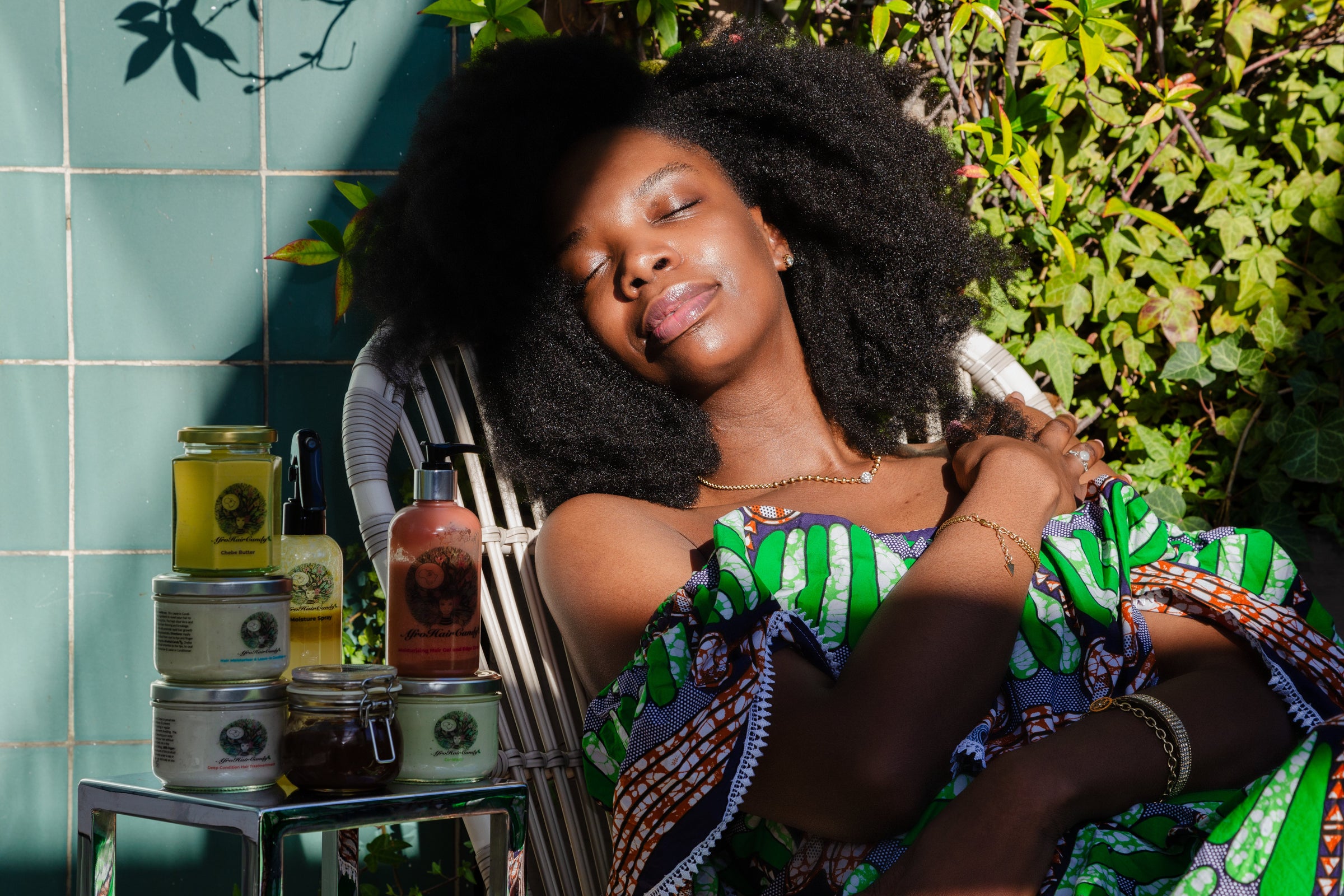
AfroHairCandy is not by my might.
It is an ancient recipe, passed from generation to generation in Africa. It is still a way of life for the vast majority of rural Africans — and it is used across parts of the Caribbean. It was never a trend. It was never a brand. It was simply how we lived.
I am Carine Mbembi Whyte. I come from a remote village in the Democratic Republic of Congo — from the Bandundu village and tribe. Our way of life there was beautifully simple. No chemicals. No synthetic products. Nature provided everything we needed to care for our skin, our hair, our teeth. We did not think of it as natural haircare. It was just life.
My family moved to London when I was 10 years old.
I noticed immediately that hair was hidden on this side of the world — under wigs and weaves, away from sight. My family too left behind what we knew, moving onto westernised methods of haircare and chemically enhanced products. And we noticed what happened. Our hair got shorter. Less body. Less length. Our scalps became dry and problematic. We were buying products that were slowly undoing what nature had spent generations building.
I kept making what I could — as I had done as a child in the village — with the limited resources available to us in the UK.
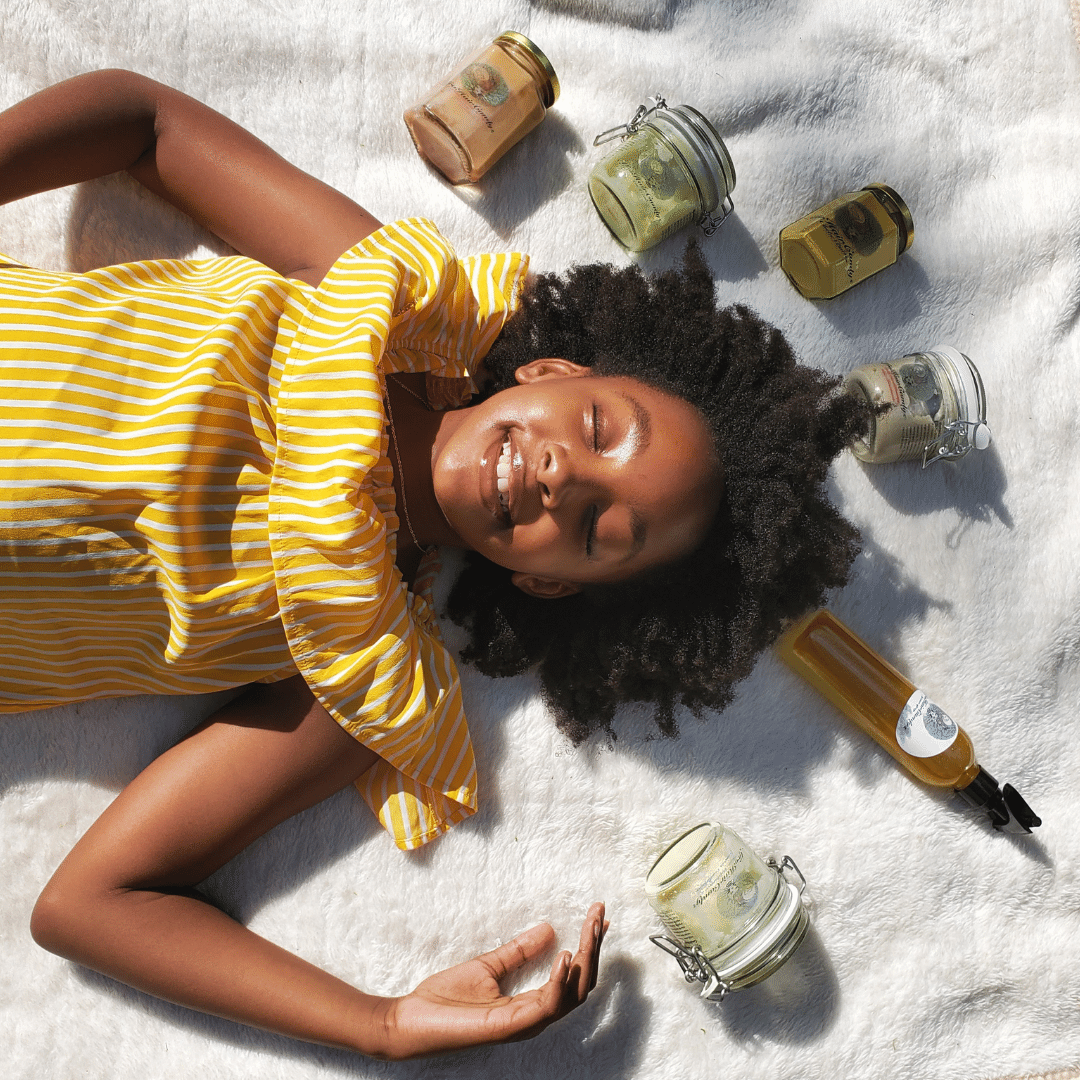
When my first daughter was born, my husband said something I have never forgotten: "It starts with you loving your natural hair, and not treating it as a problem. She will learn from you." He had already seen me make products that cleared his severe psoriasis. He had seen his own hair loss reverse. He had every faith. So I kept going.
When our twins were born, my grandmother insisted — as our culture dictates — that a baby's first hair wash should be with oils. I ignored her and used a popular baby shampoo instead. The burns my daughter suffered told me everything I needed to know. I never went back.
By this point I had studied Biomedical Sciences and Cellular and Molecular Biology at the University of Oxford. My modules included trichology — the clinical science of hair and scalp — and dermatology, which gave me the biological framework to understand exactly what the chemicals in mainstream haircare products were doing to the follicles, the scalp barrier and the skin. I had also studied healing herbs at the University of KwaZulu-Natal in South Africa — one of Africa's leading research universities — where I learned the science behind the botanical compounds my ancestors had used instinctively for centuries.
My studies did not teach me something new. They taught me why what we already knew worked.
I started making products seriously — in batches, with feedback, with pictures. For friends, then friends of friends, then family, then school mums, then their friends. They all asked the same question: how is your hair like that? The answer was always the same. Plants. Seeds. Oils. Nothing else.
I kept in close touch with everyone. Asked for feedback. Asked for photos. And what I found went far beyond healthy hair and growth. The products were reversing serious cases of alopecia. Not just my husband's baldness. Not just my own edges and bald patches from years of traction and chemical processing in my teens. Women who had been told there was nothing to be done. Women who had stopped expecting results.
This was not luck. It was the science of what these ingredients do at the cellular level — applied with the knowledge of what our ancestors understood intuitively long before laboratories existed.
Then my mother was diagnosed with Melanoma. And the chemotherapy began. And I refined the formula again — this time for a scalp under the kind of pressure that only cancer treatment creates. I researched every ingredient from a cellular biology perspective — what each botanical compound does to inflamed tissue, to compromised follicles, to a scalp under chemical stress. I sourced deeper, travelling to Congo for ingredients that grow nowhere else on earth. And I made it again — for a scalp going through something far harder than thinning.
It helped. Her scalp stayed calmer than it should have. Her hair came back.
I have never stopped making it since.
That formula became the Chebe Hair and Scalp Serum. It takes up to 18 months to make per batch. Several of its ingredients — including Congo Eucalyptus Root and Bulukutu — are harvested exclusively in the Congo. When conflict disrupted our supply chain last year, I waited nine months rather than substitute them. Because the cellular biology of why those specific botanicals work the way they do is not something I can replicate with an alternative.
Today AfroHairCandy sources ingredients across 18 African countries. We operate over 2,000 hectares of farmland in Congo — the country where I was born — growing ingredients under our direct control. For every ingredient we do not grow ourselves, I travel personally to meet the farmer, inspect the land and verify that nothing synthetic has touched the crop.
I was supposed to become a gynaecologist. Life took me somewhere else. But the science never left.
I am grateful to everyone who tried these products before they had a name. Who gave me feedback. Who called me when the products went off to help me measure shelf life. Who nagged me to make more. Who pushed me to refine them for modern use. You are the reason this exists.
AfroHairCandy is a natural haircare system built on the knowledge of our ancestors, the science of two universities, and 22 years of real results on real women. It ensures we are able to care for our hair and skin the way nature intended — using only plants, seeds and oils.
No synthetics. No preservatives. No fillers. No compromises. Not in the village. Not in the laboratory. Not ever.
Welcome to AfrohairCandy.
—
Carine Mbembi Whyte
BSc Biomedical Sciences, Cellular & Molecular Biology — University of Oxford
Trichology & Healing Herbs Specialism — University of KwaZulu-Natal, South Africa
Founder, AfrohairCandy